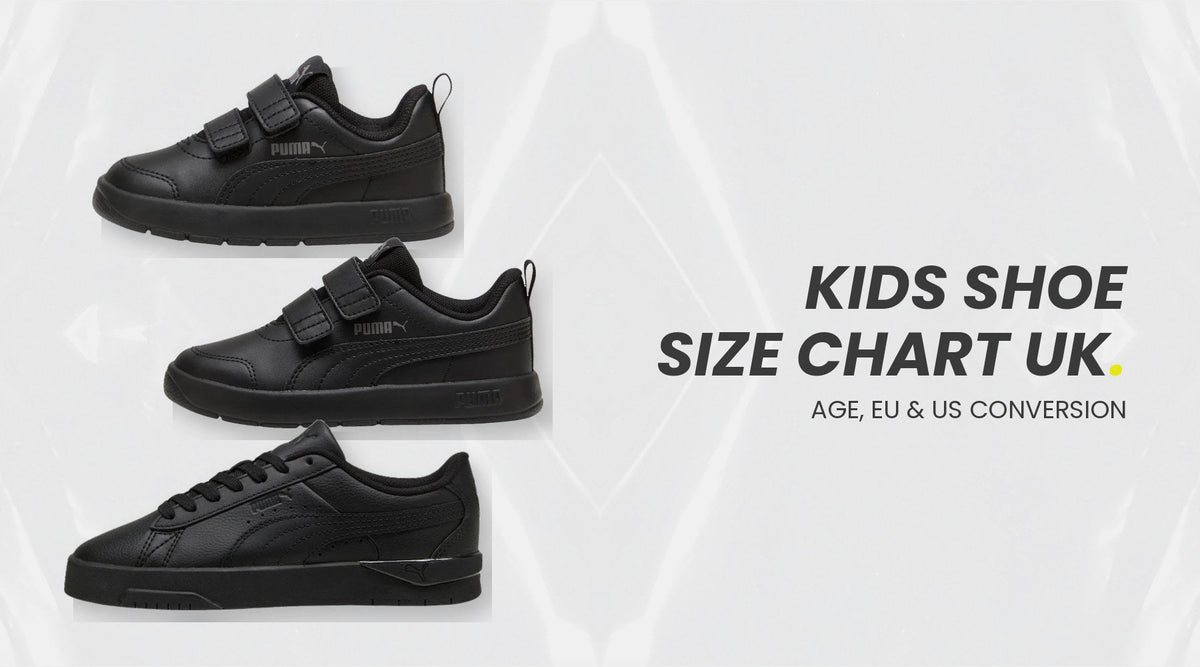

Quick answer: For Year 7 you want a black leather school shoe or an all-black school trainer in a UK size 3–7, bought with about a thumb’s width of growing room and re-measured at Christmas. Most Year 7s go up half a size to a full size during the school year, so one pair rarely lasts from September to July — budget for a second pair in the spring rather than buying a size too big in August.
What actually changes about shoes in Year 7
Two things change at once, and that is what catches parents out. The first is the uniform policy. Primary schools tend to be relaxed about footwear; secondary schools almost always specify plain black, and a good number specify black leather with no visible logo, no white soles and no coloured stitching. A trainer that sailed through Year 6 can get a detention slip in Year 7.
The second is the feet themselves. Year 7 sits right at the front edge of the pubertal growth spurt — feet often finish growing well before the rest of a child does, which means the fastest foot growth many children ever experience happens between roughly ages 11 and 14. A shoe bought in late August can be genuinely tight by February.
The practical consequence: buy for the foot you have now, not the foot you are hoping to avoid buying for in March. Oversized shoes slip at the heel, which causes blisters, ruined heel counters and a shoe that dies faster than a correctly fitted one would have.
School shoes or school trainers — what the rules actually say
“Are trainers allowed?” is the single most common question we get in the shop in September, and the honest answer is that it depends entirely on your child’s school — the rule is set per school, not nationally.
In practice UK secondary uniform policies fall into three groups:
- Formal shoes only. Black leather or leather-look, closed toe, low heel. Trainers of any kind are refused, including all-black ones.
- All-black trainers permitted. The most common policy now. The shoe must be black throughout — upper, sole, laces, eyelets and branding. A black shoe with a white swoosh or a white sole usually fails.
- Sports-brand trainers permitted. A minority, and usually still with the all-black condition attached.
Read the actual wording in your school’s uniform policy before you buy, and pay attention to the word “plain”. Schools use it to mean no contrast sole and no visible logo, which rules out a lot of shoes that look black at a glance in a photograph. If you are unsure, bring the policy into the shop with you — we read a lot of them.
One more distinction worth making: school trainers and PE trainers are not the same purchase. A school trainer is a smart all-black shoe worn all day; a PE trainer is a sports shoe with grip and cushioning for the sports hall. Trying to make one pair do both jobs wears them out roughly twice as fast and usually breaks the “plain black” rule in the process.
Sizing: the bit the big brands’ guides skip
Every buying guide tells you to leave a thumb’s width of room. Almost none of them tell you what to do about January.
Here is what we actually recommend to Year 7 parents at the counter:
- Get both feet measured, in the afternoon. Feet swell across the day and one foot is usually slightly larger. Fit to the bigger foot, later in the day.
- Leave 12–15mm at the toe, not more. That is roughly a thumb’s width. Two sizes up is not thrift, it is a heel that slips and a shoe that fails by Easter.
- Check the width, not just the length. Length is the number on the box; width is the reason the shoe hurts. Many school shoes only come in a standard width, which is exactly why measuring in person matters.
- Re-measure at Christmas. Half the Year 7s we see in January need the next size. Knowing that in December is cheaper than discovering it when the shoe splits.
- Two cheaper pairs often beat one expensive pair. Alternating pairs lets each dry out fully between wears, and leather that dries properly lasts materially longer.
Brand sizing also varies more than parents expect — a Puma UK 4 and an Adidas UK 4 are not always the same shoe internally. Our shoe size guide shows how much conversion charts move between brands.
How long should a pair last, and what kills them first
A well-fitted pair worn five days a week should comfortably manage two terms. Where they die early, it is nearly always one of four things: heel slip from a shoe bought too big, wet shoes dried on a radiator (which cracks leather and unglues soles), the same single pair worn every day without a chance to dry, or a school trainer being used for PE and football as well.
Two habits do most of the work. Wipe them clean weekly rather than monthly, and never dry them on direct heat — stuff them with newspaper and leave them somewhere room temperature. If you are in a Cardiff school, assume they will be soaked at some point in November, and plan for a second pair on that basis.
Our picks at YC Sports
These are in stock now at our Cardiff shop and online, in the sizes Year 7s actually need. All are black and suit an all-black trainer policy — check your school’s wording on soles and logos before ordering.
- Puma Caven 2.0 Jr — £38.00. In UK 3, 4, 5 and 5.5, which is the core Year 7 band. The default recommendation for a first secondary-school trainer: hard-wearing, genuinely all-black and easy to keep clean.
- Adidas Advantage Kids — £33.00. In UK 3, 5.5 and 6.5. A full black-on-black colourway, so it passes the stricter “plain black” policies that reject a contrast sole.
- Puma Jada Classic Junior — £38.00. In UK 3, 4 and 5. A slimmer last than the Caven, which suits narrower feet that swim in a standard-width shoe.
- Puma Caven 2.0 — £55.00. In UK 6, 7 and 7.5, for the Year 7s who are already in adult sizes. Same shoe as the Jr in a grown-up size run.
- Puma Courtflex V3 Kids — £25.00. In UK 3, 4 and 5. The sensible second pair — cheap enough to alternate with the main shoe, which is what actually makes both pairs last.
The full range is on our school shoes collection. If you would rather have them measured properly, bring your child into the shop — we have been fitting school shoes in Cardiff since 1983, and it takes about five minutes.
Frequently asked questions
Are black trainers allowed as school shoes in Year 7?
At many UK secondary schools, yes, provided they are black throughout — upper, sole, laces and logo. A black shoe with a white sole or a contrasting logo usually fails. Some schools still require formal leather shoes only, so check your school’s written uniform policy rather than assuming.
What size school shoes does a Year 7 need?
Most Year 7s (age 11–12) are between a UK 3 and a UK 7, but the spread is wide at that age and guessing from age charts is unreliable. Have both feet measured and fit to the larger one, leaving 12–15mm of growing room.
How many pairs of school shoes should we buy?
Two if you can. Alternating pairs lets each dry out properly between wears, which extends the life of both, and it means a soaking in November does not leave your child in wet shoes the next morning.
How long should Year 7 school shoes last?
A correctly fitted pair should last two terms. Expect to re-measure at Christmas — a large share of Year 7s go up half a size to a full size during the school year, so plan for a replacement pair in the spring rather than buying oversized in August.
Do school shoes and PE trainers need to be different?
Yes, in practice. A school trainer is worn all day and has to satisfy a uniform policy; a PE trainer needs grip and cushioning for sport. Using one pair for both roughly halves how long they last.
Getting it right first time
Year 7 is the year where a shoe bought on a guessed size causes the most trouble, because it is the year feet move fastest and the year uniform rules get strict. Measure properly, buy for the foot in front of you, and plan for a second pair rather than a bigger one.
If you are working through the whole Year 7 list, our guide to what changes in the uniform between Year 6 and Year 7 covers ties, sizing and what parents over-buy in August, and how school uniform ordering works in Cardiff explains lead times for named-school items. Or come and see us — browse the school shoes range online, or bring them in and we will measure them properly.
Quality schoolwear that is worth every penny
Good uniform is an investment in your child's school year. Every item we sell is chosen for quality first: stronger fabrics, reinforced seams and colours that stay true wash after wash. It is built to last longer than typical supermarket uniform, so it keeps looking smart all year and works out as excellent value. Families across Cardiff and South Wales have trusted us with their school uniform since 1983.
Our recommended school shirts and trousers:
- Winterbottom's Long Sleeve School Blouse – White (£16.00). A crisp, hard-wearing school blouse from our Winterbottom's shirt range.
- Winterbottom's Short Sleeve School Blouse – White (£16.00). The same quality in a cooler short-sleeve cut for the summer term.
- LIM Mens School Trouser (Charcoal) (£15.00) and LIM Junior Boys Trouser (Black) (£13.00). Smart, durable trousers that hold their shape.
- LIM Slim Ladies Fit Trousers (Charcoal) (£15.00) and LIM Junior Girls Trousers (£15.00). A flattering fit that stays comfortable all day.
- LIM School Skirt (Navy) (£10.00), LIM School Skirt (Black) (£10.00) and LIM Pencil Skirt (£11.00). Hard-wearing school skirts at a great price.
Find your school's full uniform on our schoolwear page or browse school essentials.