
Quick answer: Buy a wooden hockey stick if the player is a genuine beginner — primary school, first term of secondary school hockey, or a taster course. Wood is softer on a bad first touch and cheap enough that losing it does not matter; ours start at £15. Move to a composite stick (carbon and fibreglass) once they are playing weekly for a club or school team: composites are lighter and do not go soft in the wet, and they now start at £30 — close enough to wood that price is rarely the deciding factor.
The honest difference between wood and composite
A wooden stick is a laminated hardwood shaft, usually mulberry or maple, sometimes with a thin fibreglass wrap around the head. A composite has no wood in it at all — carbon fibre, fibreglass and often aramid, laid up in resin around a core. That shows up in four places that matter on a Saturday morning:
- Weight. Wood is heavier for the same length and carries it lower down. A tired ten-year-old in the last quarter feels this.
- Feel on the ball. Wood flexes and damps, so a mistrap thuds rather than stings. Composite is stiffer and the ball comes off the face faster — great once you can control it, messy before then.
- Water. The one nobody mentions. Wooden sticks absorb moisture; left in a wet kit bag over a Welsh winter they get heavier, then softer, then they delaminate. Composites do not care.
- Damage. Wood chips and splinters at the toe and edges. Composite chips too, but survives being jammed into a turf better.
When a wooden stick is genuinely the right buy
Four situations, more common than the hockey internet admits:
- A beginner who may not stick with it. Year 3 to Year 7, or a taster block. A £15 stick used twice is a good outcome; a £90 one is not.
- Learning core skills. The forgiveness is a coaching advantage — a softer stick makes a poor trap less punishing, so the player keeps their body behind the ball rather than flinching away.
- A spare. Every club player who has had a stick crack mid-season knows why a cheap wooden one lives in the car.
- PE only. If hockey is six weeks of the curriculum, wood is the sensible spend.
When to go composite instead
Switch as soon as any of these are true: they have been picked for a school or club team, they are training more than once a week, they have outgrown their wooden stick's length, or that stick has been through a wet winter and feels dead.
The trigger is playing frequency, not age. A keen nine-year-old in a club development squad is better served by a light 28" composite than by wood. A fifteen-year-old doing PE hockey twice a year is not.
The £30 crossover most guides have not caught up with
Every buying guide online still repeats that wood is the budget option and composite is the upgrade. That was true a decade ago. Our cheapest composites are £30 and our wooden sticks £15 to £25.50 — the gap is one tank of petrol. So the real question is no longer "can I afford composite?" but "will this player benefit from the stiffness, or will it work against them?" For a beginner the £15 wooden stick is still the better hockey decision, not just the cheaper one. For anyone in a team, spending £15 to save £15 is a false economy.
What schools in Cardiff actually ask for
We fit school hockey kit across Cardiff and South Wales, and the letter home almost never specifies a material. What it does specify is a gum shield and shin pads — compulsory in most school hockey, and the things parents forget. Three points worth knowing:
- Most schools will not mind wood or composite for PE. Team selection sometimes brings a stiffer requirement, but that is about the player, not a rule.
- Indoor hockey uses a different stick — thinner, lighter, smaller head. If your child has been picked for the winter indoor block, an outdoor stick is legal in some leagues and not others. Check with the coach before buying a second.
- Left-handed sticks do not exist in field hockey. Every stick is right-handed — a rule of the game, not a stocking decision.
Get the length right before you worry about the material
This matters far more than wood versus carbon, and it is the most common mistake we correct in store. A stick that is too long ruins body position, and one bought "to grow into" teaches bad habits for a year. Sizes run in inches — 28, 30, 32, 34, 35, 36.5 — set by the player's height, not their age.
Our hockey stick size guide has the height-to-length chart, and our explainer on what carbon content actually does covers why a junior does not need a 90% carbon stick.
Our picks at YC Sports
All five are in stock as we publish. Sizes are limited on the wooden sticks, so check the size you need first.
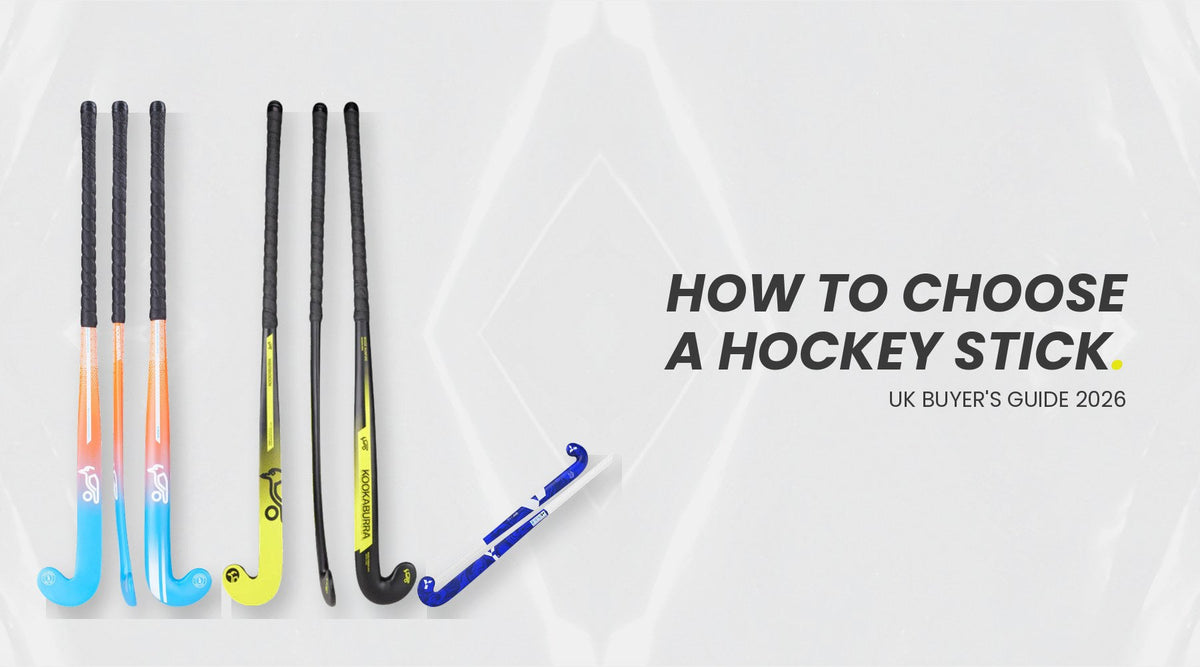
- Kookaburra Strike Wooden — £15.00. The starter stick we hand to parents whose child is trying hockey for the first time. Currently 30" only.
- Kookaburra Orbit Wooden — £25.50. Better finished, with a fibreglass wrap, so it tolerates a wet season better. Currently 32".
- Kookaburra Sunfire — £30.00. Our pick of the entry composites, and the best size run we hold: 28", 30", 32", 34". Moving a child off wood? Start here.
- Kookaburra Twist — £30.00. Same bracket as the Sunfire, in mint and pink. 28", 30", 35".
- Y1 JMB Junior 2026/27 — £49.99. The step up for a junior playing club hockey weekly — mid bow, lighter, a proper season-long stick. 32" and 34".
The full range, including senior composites, sits in hockey sticks, and grips, bags, gum shields and shin pads are in hockey accessories.
Frequently asked questions
What field hockey stick is best for beginners?
A wooden stick in the correct length, or the cheapest composite if the player has already joined a team. For a first-timer we would put a £15 wooden Kookaburra Strike in their hands over a £90 composite every time — the expensive stick makes a beginner's first touch harder to control and stings when they mistrap. Spend the difference on a gum shield and shin pads.
What is the best hockey stick for beginners in the UK?
For school hockey, a 28" to 32" wooden stick at £15 to £25. For a beginner who has committed to a club, an entry composite around £30 such as the Kookaburra Sunfire. Above roughly £70 you are paying for carbon content a new player cannot yet use.
Which hockey stick material is best?
Neither is better in the abstract — they suit different players. Wood is better for beginners because it is forgiving and cheap. Composite is better for anyone playing regularly because it is lighter, stiffer and waterproof. Wooden sticks remain fully legal in UK outdoor field hockey at every level.
How long does a wooden hockey stick last?
One to two seasons of weekly play, less if it lives in a damp kit bag. The failure is moisture, not impact: the shaft absorbs water, gains weight and eventually delaminates. Dry it after wet matches and it will see out a school year. A child usually outgrows the length first.
Can I try hockey sticks before buying in Cardiff?
Yes, and you should. Two minutes holding three sticks tells you more than an hour comparing specifications, and it is the only reliable way to check length against the player rather than a chart. We have been fitting sports kit in Cardiff since 1983.
The short version
Wood for beginners and PE, composite for anyone in a team, and get the length right before you think about either. Not sure which side of the line your child sits on? Bring them in — find us and our opening hours here — and we will size them properly and tell you honestly when the cheaper stick is the better buy.